Donald Gardner reviews The Serpent and the Fire: Poetries of the Americas from Origins to Present
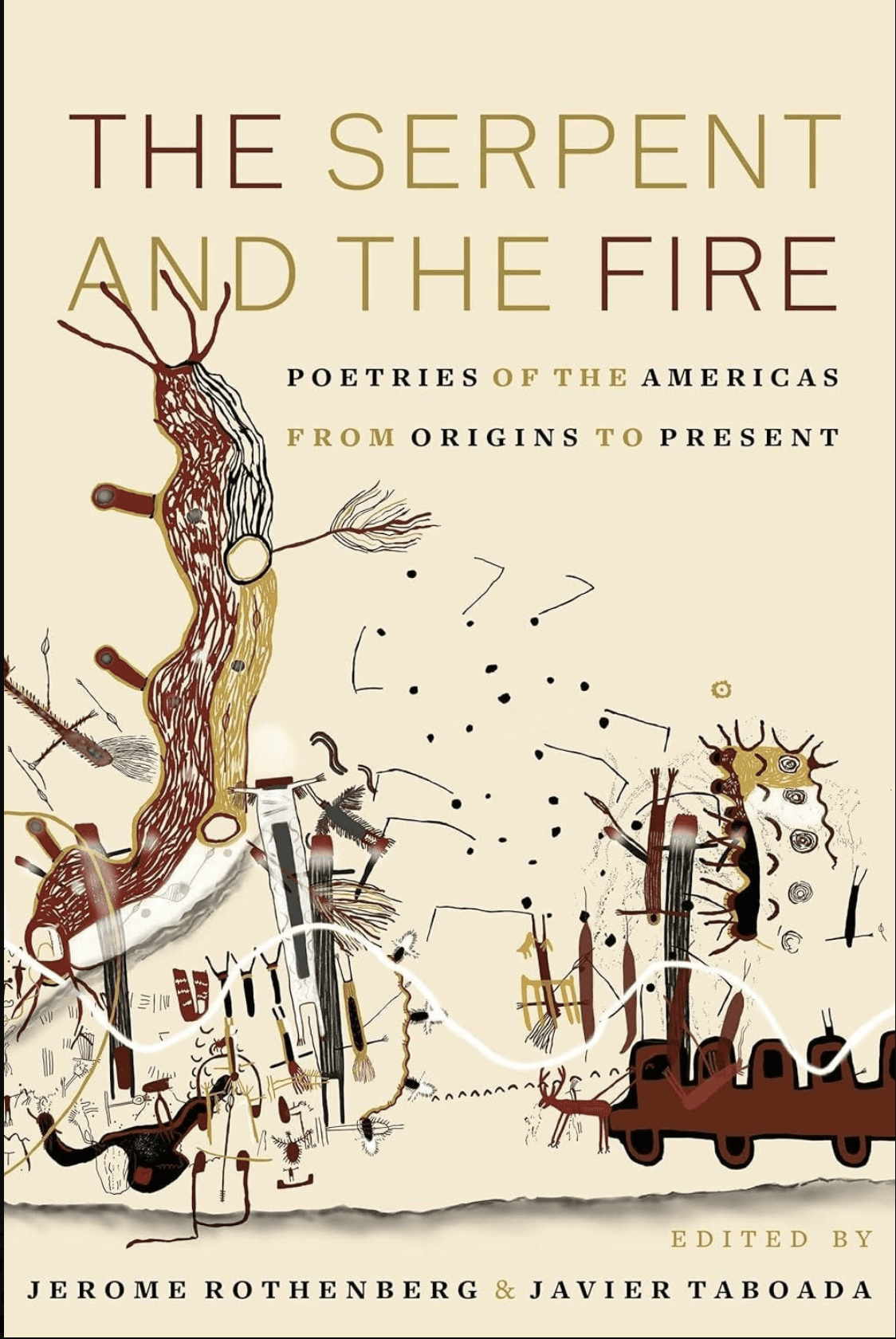
The Serpent and the Fire; Poetries of the Americas from Origins to Present.
Edited by Jerome Rothenberg and Javier Taboada.
University of California Press, 2024 / p. 816 / $34.95 / £30.00 ISBN 9780520303546
Review by Donald Gardner
Jerome Rothenberg, American poet and anthologer, died last year aged 92. He was active until the end of his life and his last publication, The Serpent and the Fire, an anthology of the poetry of the Americas—all the Americas, pre- and post-Colombian—was published shortly after his death in 2024. Co-editor of the anthology is Javier Taboada, a Mexican who also translated many of the Spanish-language poems.
Rothenberg, a New Yorker who moved to California, was a distinguished poet, but he will be especially remembered for his anthologies, all of which are also statements about poetry. He set the tone back in 1969 with Technicians of the Sacred, a selection of poems and ritual texts from five continents. In 1972, he went on to publish an anthology of poetry on his own doorstep, Shaking the Pumpkin: Traditional Poetry of the Indian North Americas. Much later, in collaboration with Pierre Joris, he published Poems for the Millenium in two volumes (1997 and 1999). These are world anthologies, and they invite the reader to compare different traditions and tendencies in poetry during the past century, modern and postmodern.
In The Serpent and the Fire, his final anthology, published posthumously, Rothenberg does something surprising; he fuses the two themes of his earlier anthologies, juxtaposing sophisticated second-generation New York school poets, for instance, with Indigenous poets, north and south. It makes for a strange confrontation. He explains his idea in the short introduction.
The principle is that of inclusivity; contradiction and disagreement are embraced. The Serpent and the Fire is a manifesto for what he calls ‘omnipoetry’. Multiple voices are fundamental to his vision, nothing may be left out and every expression has its intrinsic relevance. The work of pre-Columbian tribes meets the 60s avant-garde, meets Brazilian modernism. Rothenberg is comfortable with the intellectual “difficulty” of some of the poets of his own time and place; he juxtaposes this with the statements and songs of ancient tribes and peoples. His definition of poetry may feel radically new, and yet all it does is give back the idea of poetry to the original inhabitants of the continent. His collections can be called conservative and revolutionary at the same time.
Take the very first poem in the book, which is in fact the cover, as above. What we see is a pictogram, a reproduction of a shamanistic mural from a cliff face in the Lower Pecos Canyon in Texas, perhaps 2500 years old. Many of the early poems in this anthology are picture-writing by native, pre-conquest Indigenous peoples, north and south. Later, there is a photo of the Serpent Mound, an enormous, very long earthwork in Adams County, Ohio, which Rothenberg describes as a monumental poem. Later in the book, there are two classic modernists. There is a sequence from Eliot’s “The Waste Land”, the “Death by Water” sequence, and a poem by Pablo Neruda, “Walkin’ Around”:
“It just so happens that I’m tired of being a man. / It just so happens that I walk into tailor shops and movies, / withered, impenetrable, a flannel swan / that steers across a sea of origins and ashes.”
Later still, there are translations of poems originally written in Mapudungun (the language of the Mapuche nation of Chile), Ladino, Papiamento and Calunga, an Afro-Brazilian secret language. In “Calunga Lungara”, Edimilson de Almeida Pereira writes:
“I am going to put into words/ what is not possible. They are water-words / that dissolve. // I am speaking of Calunga.”
Some of these poems are described as having been “transcreated” rather than translated; it’s easy to understand why. One concern seems to be to rescue certain languages from oblivion. There is also a poem by the Argentinian modernist, Xul Solar, written in Pancriollo, which is a mix of Spanish and Portuguese, but is essentially a language that Solar himself invented. All the poems or poem-sets in the book are accompanied by a commentary, backgrounding the author and her/his context.
It is a far cry from my first-ever anthology of poetry, The Golden Treasury of the Victorian, Francis Palgrave that I was given as a ten-year old and which, eager as I was for things I didn’t understand, I doted on. And yet all these gatherings of poetry have something in common. Collections of a wide range of poets can be seen as riches. Palgrave’s word says it all: it’s a treasury. Perhaps we can think of poetry as an alternative currency. The Serpent and the Fire is nothing if not a treasury.
The book embraces North and South America as a unity. It includes translations of major Hispanic and Portuguese-language poets, placing them side-by-side with a procession of the U.S. postwar avant-garde. With these juxtapositions, it raises the question of what poetry is, and what kind of poetry we should take with us into the future.
The Serpent and the Fire is a portrait in poetry of the Americas, in depth and through time. There is a prose piece by the ‘founder’ Simon Bolivar, from Venezuela, which has an extraordinarily modern resonance, and a prose monologue by Emily Dickinson. There is a piece by Smohalla from Nez Perce, the driving force behind the Dreamer Religion:
“My young men shall never work, men who work cannot dream; and wisdom comes to us in dreams.’ The spread actually is unimaginable.”
There is also a long extract from “The Ghost Dance”, a visionary poem by the revolutionary poet-priest Ernesto Cardenal that I translated back in 1969, after I had visited Cardenal on Solentiname, the island in the Lake of Nicaragua, where he had founded his commune of poets:
Rothenberg’s book is an inquiry into what America is—a question that has obsessed Americans, north and south. Moreover, it is a self-scrutiny that has never seemed to be a part of European literature. It interrogates the America, north and south, that exists by right of conquest, and that is buried, properly so, in an anguished need to define itself.
There are voices of Indigenous poets, speculating on how they might live peaceably with the White settlers. And others, often from the southern part of the continent—modernists even in the nineteenth century—who yoked poetry to a radical idea of social reform. There is Oswald de Andrade (1890-1954), from Brazil:
“Poetry went hidden in the malicious vines of learning. In the lianas of academic nostalgia.”
Parallel to the modernist poets from Latin America is a galaxy of Rothenberg’s own contemporaries, from the second half of the last century in North America: Paul Blackburn, Robert Duncan, Denise Levertov, Diane di Prima, Anne Waldman, Gary Snyder and many others. The 60s and 70s, two generations ago, was a period of serious innovation; it was perhaps the last time when poetry was driven by an optimistic vision. Rothenberg stops at the millennium. His plea is that poetry since then hasn’t had sufficient time to shake down for a proper selection to be made. He wants to “minimize the possibility of misrepresenting or ‘canonizing’ the more recent generations of poets.” The resulting impression is of a cliff-hanger, a challenge, as it were, to ask ourselves, What does our poetry look like? And how will it look to a future generation?
There are one or two exceptions to Rothenberg’s rule. He includes, for instance, Joy Harjo, born 1951, Cree Nation poet and poet laureate (2019-2022). Her poem is generous and visionary:
“We were never perfect. // Yet the journey we make together is perfect on this earth who was once a star and made the same mistakes as humans. // We might make them again, she said. // Crucial to finding the way is this: there is no beginning or end. // You must make your own map.”
There are poets here with whom many readers will be unfamiliar, particularly some from modern Latin American poetry. There is Juan L. Ortiz (Argentina, 1896-1978), who wrote an epic about the Gualeguay River:
“The river was all of time, was everything ... / tweaking all the courses of its lines / as Eden’s orchestra beneath the rod of love ... / he was love, the river ... / Everything was born from him, or came evangelically to him.” (tr. Paquito d’Rivera)
Or, from the other end of the same continent, there is the Puerto Rican poet, Luis Palés Matos (1898-1959), whom Rothenberg describes as calling for “a true Antillean poetry, which would explore new forms, not exclusively Black, but Criollo and Indigenous as well”:
“Down the scorching Antillean street / goes Tembandumba of the Quimbamba / Between two rows of black faces / –Rumba, macumba, candombe, bambula. / Before her a congo band thumps / A bombastic conga–gongos and maracas. // Steatopygously the Queen steps up / And her immense buttocks with drums collide / So that seductive wiggles slide / In curdled rivers of sugar and molasses.”
And then there is an excerpt from ‘Borderlands/ La Frontera’ by the marvelous Mexican/U.S. poet, Gloria Anzaldúa (1942 -2004):
“Beneath the iron sky / Mexican children kick their soccer ball across, / run after it, entering the U.S.”
The reader of this anthology will come away with a very different picture of the Americas, and perhaps of what poetry is capable of and perhaps of poetry itself.
https://fortnightlyreview.substack.com/p/the-serpent-and-the-fire-on-american